
e160i Kestrel
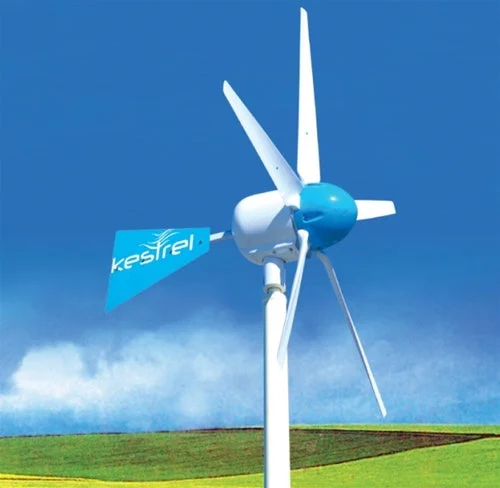
Product Description:
Wind‑powered generators that produce electricity, often used in hybrid solar‑wind systems. Kestrel wind turbines are among the best performing and most efficient wind power systems. Kestrel’s strict adherence to quality standards and continuous development of Kestrel technology has resulted in a line of high quality, quiet, powerful, and robust machines in 600, 800, 1000 and 3000 Watts rated power that are both reliable and cost effective.
All Kestrel turbines feature Full Axial Flux Discoid Technology, for high efficiency and increased energy production in lower wind areas. All models use patented pitch control, allowing blades to maintain rated output in excess wind speeds and optimizing overall power production.
Energy may be harvested at any different wind speed exceeding cut-in speed and rated output is maintained through rotor turbulence and pitch control in high winds. Energy output is intrinsically linked to your site’s wind distribution, topology and altitude as well as tower height and the height of trees or structures in the area.
Product highlights:
- 4.3 mph cut in wind speed, 29 mph rated wind speed
- Compact and virtually silent, the e160i uses 5 fiberglass blades with a 5.24-foot rotor diameter, making it the smallest model on our floor
- Used around the world and in Alaska to power railway switches, public lighting, communication towers, and for education
- Appropriate for battery charging, grid tie or hybrid systems, the output voltage can range from 12 to 200 Vdc
- Tower top mass is 66 lbs
- Monopole used with a charge or voltage limiter
Product Specifications:
- Energy Type: Wind
- Suitable for: Commercial
Have questions?
Does RES design backup power for clinics and schools?
RES works with residential, commercial, and remote applications and can evaluate storage, generator integration, electrical infrastructure, controls, and ongoing support as one system.
How does cold weather affect where batteries are installed?
Alaska temperatures affect battery performance and charging, so siting, enclosures, and heating are part of the design.
Why combine batteries with a generator instead of choosing one?
Batteries carry loads instantly and silently, while a generator extends runtime when the outage outlasts stored energy.
Can a battery system keep a facility running through a multi-day winter outage?
Runtime depends on the critical-load profile, battery capacity, and whether a generator or solar recharges the system. RES designs to a runtime target agreed with the facility.
How does a business decide which loads a backup system should carry?
RES starts with an energy audit and load calculations to separate critical loads (refrigeration, servers, medical or process equipment, life-safety lighting) from loads that can wait. The critical-load list drives battery capacity, generator size, and the electrical integration design.
How do we begin planning a commercial renewable energy project?
Contact RES with your project location, facility type, current energy sources, approximate energy requirements, and operational goals.
Does RES offer commercial system maintenance and support?
Yes. RES provides operations and maintenance services, including monitoring, preventative maintenance, battery testing, troubleshooting, repairs, and system upgrades.
Can renewable energy reduce operating costs for an Alaska business?
Renewable energy may help reduce electricity purchases, fuel consumption, or exposure to changing energy costs. Actual financial benefits depend on system design, energy demand, utility rates, fuel costs, project location, and installation expenses.
Does RES work on commercial energy projects in remote Alaska?
Yes. RES serves customers across Alaska, including rural and remote locations.
Can RES integrate renewable energy with existing generators or electrical systems?
Yes. RES designs hybrid power systems that can combine renewable generation, battery storage, generators, and existing electrical infrastructure.